

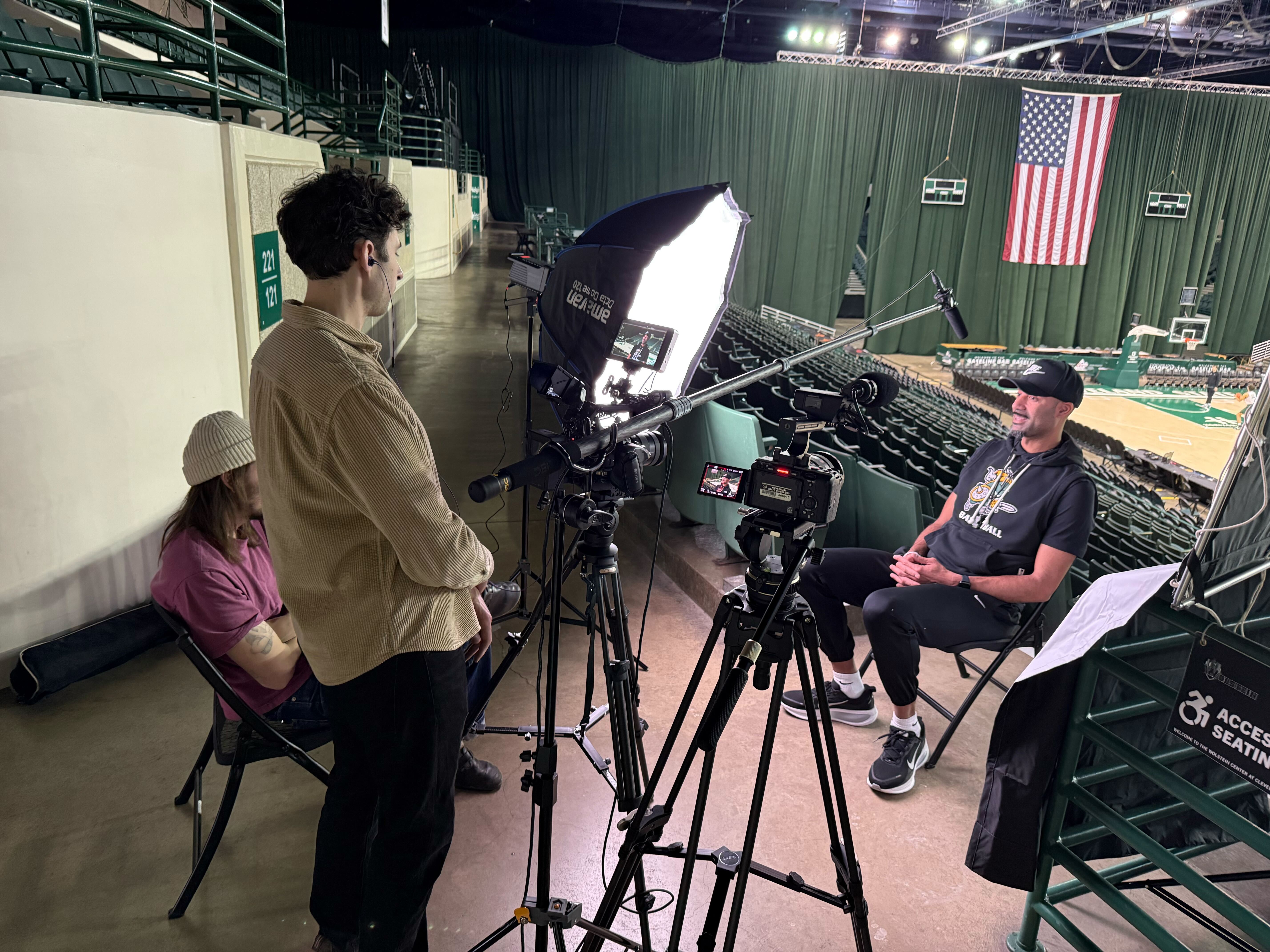
Rob Summers has been coaching college basketball for 16 years. He played professionally overseas, went back to his alma mater West Virginia University as a grad assistant under Bob Huggins, and cut his teeth at a Division II program in Glenville, West Virginia, a town of 6,000 people where he was "popping popcorn, driving vans, and sweeping floors." That experience taught him something that has shaped everything he's built since.
"It truly showed me that I love the game of basketball," Summers says. "It truly showed me I love coaching."
Now the head men's basketball coach at Cleveland State University, Summers has taken over a program he describes simply as championship-level. But he's also one of the most clear-eyed coaches in the game about what it takes to stay competitive in an era that is changing faster than anyone anticipated.
Adapting to a New Landscape
The transfer portal has fundamentally altered the rhythm of college basketball. Rosters turn over. Programs that relied on multi-year continuity to build their identity now have to find ways to establish standards and culture in compressed timeframes. Summers has a phrase for what he refuses to let happen to his program.
"We don't want to be caught with a Blockbuster card when Netflix is out."
It's a simple idea with real implications. Staying ahead means adapting in how you recruit, how you build culture, and how you train. That's where PlayerData comes in.
"For us, it's how can we build something in a short timeframe," Summers explains. "That's why we partner with PlayerData. Analytically it allows us to understand load management and adapt in the changing landscape of college basketball. You can be resourceful and do things the right way and really excel as a program."
Simple Enough to Actually Use
For Kaleb John-Lewis, Cleveland State's Director of Sports Performance for Basketball, the practical value of PlayerData shows up before practice even starts.
"PlayerData has been extremely easy to use, travel with, and get up and running," he says. "When we're on the road, just having the little carry-on, bringing all 15 chips straight in. The ease of PlayerData has been incredible."
That simplicity matters more than it might sound. In a college environment where there isn't a robust performance staff or access to an abundance of graduate assistants, a system that adds friction is a nonstarter. PlayerData removes friction entirely, fitting seamlessly into the program's daily nroutine, and the result is data that coaches can actually act on.
The buy-in from players came quickly too. John-Lewis noticed a shift the moment athletes got their first look at their own numbers.
"When players first heard about bringing in PlayerData, there was a level of excitement. When you can get athletes competing and give them an actual number to see, that just gets everyone excited, pushes all the guys to go a little bit harder, work a little bit more, and really helps add that buy-in from both the players' and the coaches' side of things."
What the Players See
For Jaidon Lipscomb, a guard on the Cleveland State roster, the data has become part of how he thinks about his own development.
"PlayerData has been very beneficial through the athlete app for us to track our numbers, to see what we're doing in and out during practice, how much energy we're exhausting throughout the day so that we're able to replenish after," Lipscomb says. "It's also great to see how hard we're working. When you're seeing how much you're running, if it doesn't meet the numbers that your standard is at, then it makes you want to work harder. It's just something to keep your mindset ready."
That self-accountability, players holding themselves to a standard because they can see exactly where they stand, is one of the most consistent things PlayerData sees across programs. The data doesn't replace the work. It makes the work mean something.
Bigger Than Wins and Losses
Bottom line, culture and identity are everything in sport. And data helps establish a meaningful culture. Ask Rob Summers what the best part of coaching is and he doesn't talk about championships or stat lines.
"The best part is just being impactful on these guys' lives," he says. "To see them learn something new and go off into the real world has been huge. To see people around Cleveland come up to me and say our guys are so respectful, those are things that to me are bigger than the wins and losses."
That's what Cleveland State is building. A program with standards that extend beyond the court, supported by data that gives coaches the certainty to make smart decisions and players the tools to push themselves further.
Play hard. Play smart. Never a doubt.
Interested in learning more about how PlayerData could help your program?
Submit your information in the form below.

.png)